
Wilson County Parole and Probation
Parole and probation both permit a person to live outside a jail or prison under rules, but they begin in different ways. Kansas parole is a discretionary release from the prison part of an older indeterminate sentence. Postrelease supervision follows the prison part of many determinate sentences. Both are administered through the Kansas Department of Corrections. Probation is ordered by a court instead of prison, while community corrections handles certain locally sentenced cases. A name leaving Wilson County Jail does not prove any of these statuses.
The record source must match the supervision type. KASPER can show KDOC parole, postrelease supervision, community corrections, or discharge data. The Wilson County criminal docket and the sentencing or disposition order are the stronger sources for court probation. KASPER warns that community-corrections probation events after April 21, 2021 cannot be displayed during its system transition, so an empty or old result needs local confirmation.
| Status | How it begins | Best public check |
|---|---|---|
| Parole | Prisoner Review Board grants release on an eligible indeterminate sentence | KASPER status and location |
| Postrelease supervision | Prison term ends under a determinate sentence | KASPER and KDOC release papers |
| Probation | Wilson County court orders community supervision | Court docket, sentencing order, or clerk record |
| Community corrections | Local court places a qualifying case in that program | Court record and supervising agency confirmation |
- Parole
- Conditional community release granted by the Prisoner Review Board.
- Probation
- A court sentence served in the community under stated terms.
- Discharge
- The point when KDOC custody and supervision have ended.
- Absconder
- A person reported as no longer maintaining required contact with supervision.
Verify Wilson County Post-Release Supervision
Start with the sentence, not an assumption. A person may have left Wilson County Jail on bond without any post-release supervision. Another person may have transferred from the jail to KDOC and remain an inmate. A KASPER result marked Parole means release from prison with KDOC control still active. Discharged is the strongest public KASPER signal that KDOC control ended.
- Open the official KASPER search disclaimer, read it, and continue to the search.
- Use the KDOC number when known. Otherwise search by name and compare birth date, identifiers, convictions, and aliases.
- Use Conviction County = Wilson only when Wilson County was the county of conviction. Residence or a brief jail stay does not make that filter correct.
- Read status with location. Preserve the exact wording, date labels, and date checked.
- For probation, check the Wilson County criminal docket and obtain the sentencing, modification, revocation, or termination order from the court clerk.
KASPER is updated each working day and covers KDOC-operated or funded programs, not every Kansas case. It is not a complete criminal history or a Wilson County booking system. The full Wilson County release-record path is explained on the released inmates home page.
The search form supports first, middle, and last name, aliases, KDOC number, KBI number, birth date or age, race, gender, conviction county, supervision type, and location. Its supervision menu includes Absconder, Community Corr., Discharged, Inmate, Parole, and other literal status choices. A result can add commitment names, aliases, a photo, physical identifiers, case and sentence facts, status, and location. Compare several fields before accepting a match. Record the check date because the working-day update cycle does not prevent a later change.
Wilson County Parole Office Route
KDOC assigns Montgomery, Wilson, and Chautauqua counties to its Coffeyville Parole Office in the South Region. That directory assignment is the best public starting point, but it does not prove that every person from Wilson County reports there. An approved home elsewhere, interstate compact placement, or another case-specific arrangement may change the office. Compare the KASPER supervision location with release paperwork before contacting staff.
The official office directory does not publish hours for this office. Staff may give public procedural help, but confidential supervision details may not be disclosed by phone.
KDOC Coffeyville Parole Office102 W. 7th Street, Suite 309
Coffeyville, KS 67337
620-625-7925
Hours: Not published
The KDOC parole-office contacts page shows Wilson County in the Coffeyville office's service area.
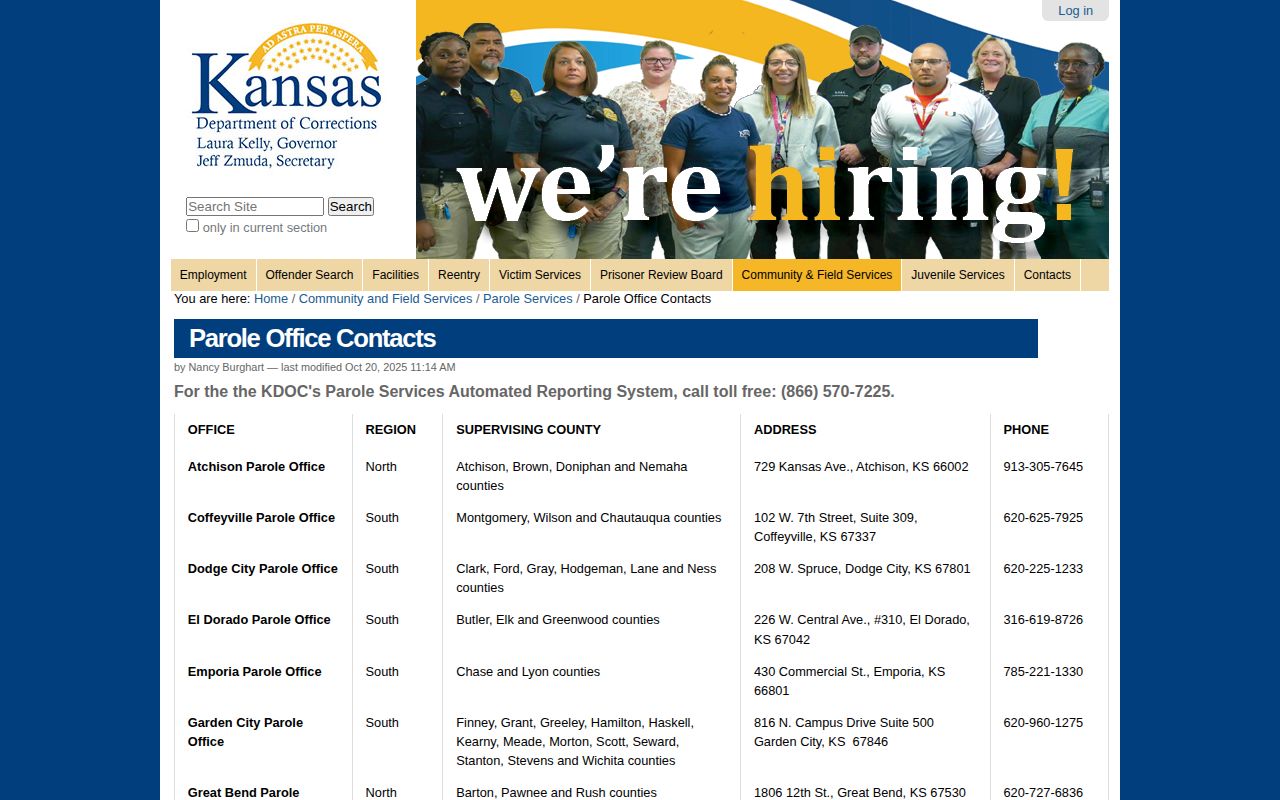
This directory image helps identify the likely office, while the individual record remains the better source for actual placement.
Wilson County Absconder Record Checks
Conditions are rules attached to release or probation. Their exact terms come from the court order, PRB action, release certificate, and supervising agency. A violation can lead to a warrant, arrest, modification, or revocation, but one reported lapse does not establish the final outcome. After probable cause and return to custody in a parole matter, the PRB conducts the final revocation hearing.
KDOC provides a separate parole-absconder search with last-supervision-location and photo options.
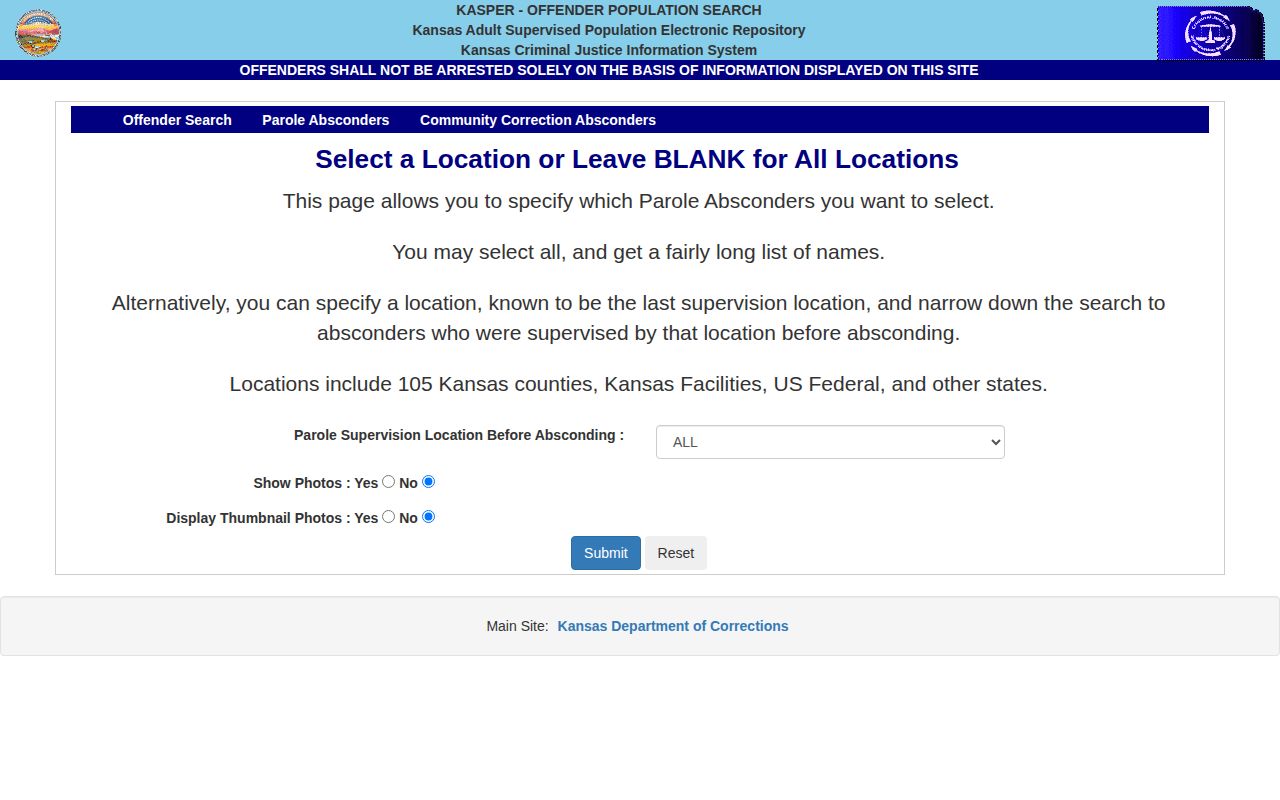
An absconder entry reports failed contact with supervision. It is not proof that a particular warrant remains active, so confirm a warrant with the issuing court or law-enforcement agency.
Court probation takes a different route. The Wilson County docket may show whether probation was imposed, modified, revoked, or terminated. A certified docket or signed order is better proof than a brief case-summary label. If an alleged violation led to detention, compare the court action with the jail event instead of assuming the old supervision record still describes current status. A person can be in custody on a probation matter even though the original sentence was community based.
When Wilson County Supervision Ends
Release from a prison building is not the same as discharge from the sentence. A person on parole, conditional release, or postrelease supervision remains under KDOC authority. The KDOC glossary defines sentence discharge or maximum sentence date as the point when the sentence has been served and KDOC supervision ends. K.S.A. 22-3722 addresses final discharge, while K.S.A. 22-3717 governs several parole, conditional-release, and postrelease rules.
Preserve a KASPER status of Discharged and any displayed date label, but obtain the underlying final-discharge certificate when durable proof is needed. Begin through the KDOC Kansas Open Records Act channel. Ask for existing records such as the release movement, supervision termination, or final-discharge entry. Kansas agencies must act on an open-records request as soon as possible and no later than the end of the third business day, though that is a response deadline rather than a guarantee of production by then.
For court probation, request the order that terminates probation from the Wilson County court. A KASPER no-result cannot prove that court supervision ended.
A precise records request should identify the full name, known aliases, birth date, KDOC or county booking number, the relevant facility, and an approximate date range. Name the existing document sought, such as a release movement, supervision termination, sentence-computation sheet, credit ledger, or final-discharge certificate. Ask for an electronic copy and a cost estimate. If part of a record is withheld, request the nonexempt remainder and the statutory basis. This narrow approach helps separate a completed Wilson County supervision term from a release that remains subject to another sentence, detainer, or agency.
KASPER accepts written accuracy comments at kdoc_pub@ks.gov. That correction address is not a replacement for the formal KDOC records channel or for Wilson County when the disputed event concerns only a county booking.
Wilson County Parole Hearing Calendar
The Kansas Prisoner Review Board handles parole decisions under the older indeterminate sentencing structure. It also sets conditions for parole, conditional release, and postrelease supervision, conducts revocation proceedings, and may discharge qualifying cases. Its public-comment schedule runs monthly, one month before the listed residents' parole hearings.
The official PRB public-comment calendar lists a session date, the next month's parole-eligibility hearings, and the earliest possible release month.
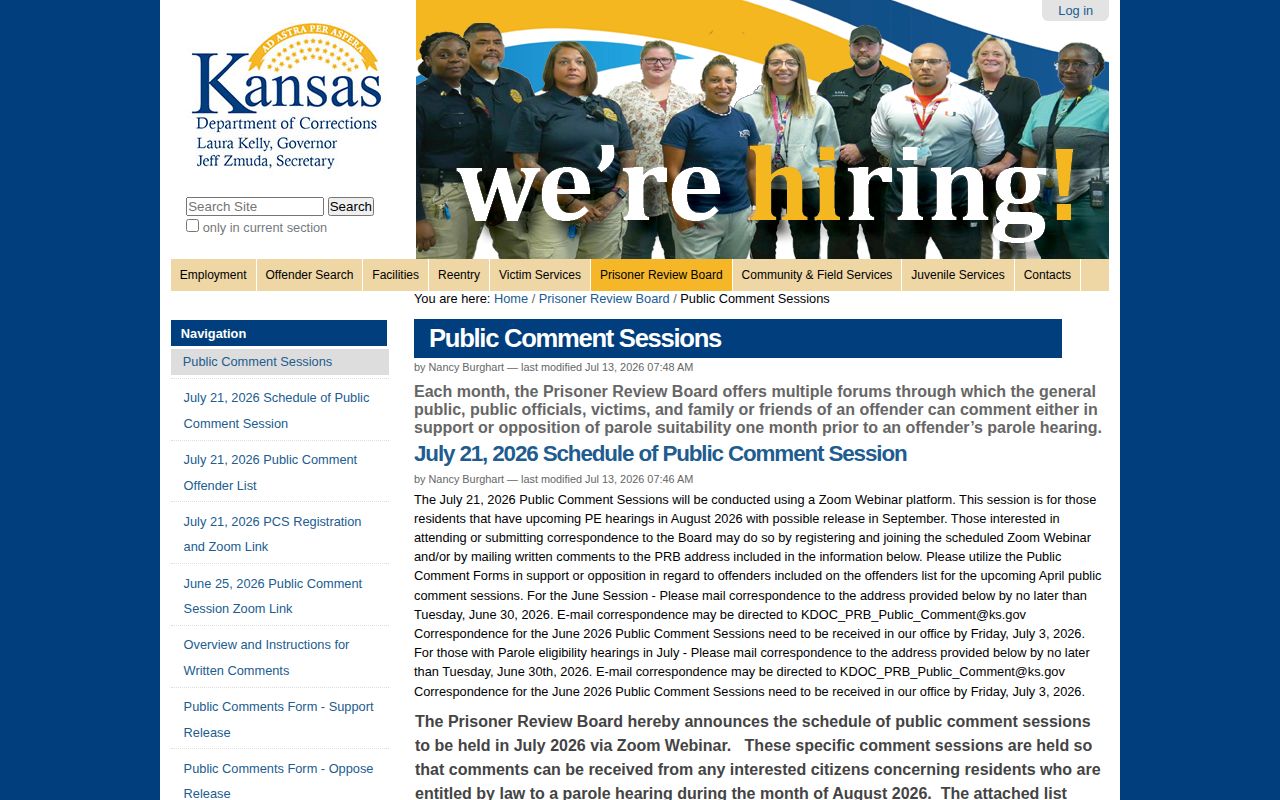
The attached list may show a commitment name, KDOC number, county of offense, case number, and offense. It is a forward-looking eligibility list, not a database of granted parole decisions.
Wilson County Parole Decision Terms
A listed hearing only means the person may be considered. The PRB separates eligibility from suitability. Kansas does not appear to offer a continuous public database of final individual PRB decisions, so check the later KASPER status or request the public part of a decision from KDOC or the Board.
The official PRB process page explains the three basic hearing outcomes.
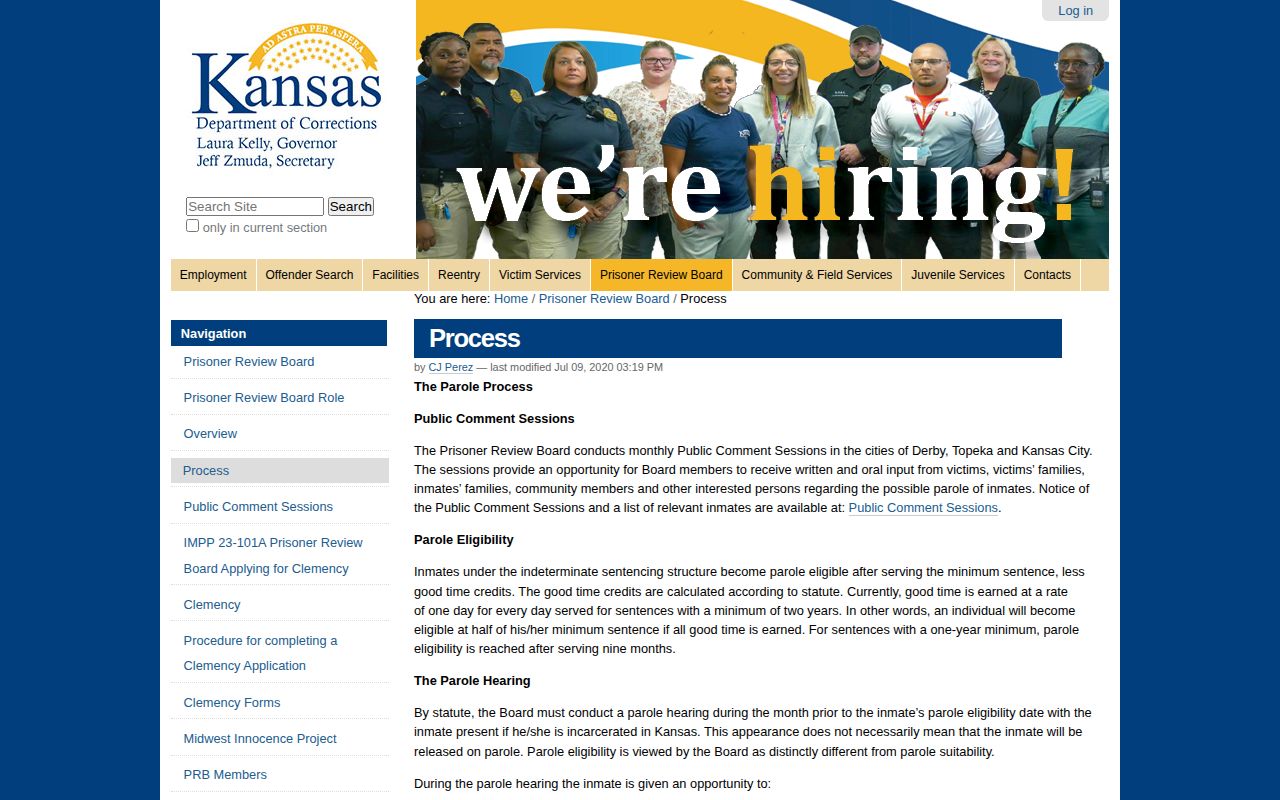
Parole is a grant subject to an approved plan and conditions. Continue delays the decision for more facts, votes, or evaluation. Pass is a denial for a stated period. Conditional release follows a statutory sentence calculation, while maximum release means the sentence has been satisfied and supervision authority has ended.
Eligibility under K.S.A. 22-3717 varies by offense date, sentence type, minimum term, credits, and exclusions. It offers a hearing opportunity, not a right to release.
The Board considers the offense, prior record, conduct and programs in prison, examination and risk information, public and victim comment, staff input, facility capacity, and proportionality. Even a Parole outcome remains subject to an approved release plan and conditions. If later KASPER data shows Inmate, the person may still be confined or may have returned after a violation. If it shows Parole, physical prison custody ended but supervision did not. Only the later record and exact status can resolve that sequence.