
Wilson County Release Date Types
A scheduled date and an actual release are not the same fact. A future date is a computation, estimate, or legal milestone based on the sentence and information then on file. An actual release date records a completed movement out of an institution. Final discharge comes later if parole or postrelease supervision continues after the person leaves prison. Under K.S.A. 22-3722, final discharge concerns the end of KDOC or Prisoner Review Board control, not merely the day a person walked out of a prison.
A Wilson County Jail detainee who has not been sentenced usually has no computed release date. The next event may depend on bond, dismissal, a plea, a sentencing order, or transfer. A county sentence also should not be run through a state-prison credit formula. The jail record and court journal entry control that local custody episode. If the jail sends a person to KDOC, the Wilson County departure is a transfer, not release to the community.
Lookup Wilson County Release Dates
Begin with the system that holds the person. The Wilson County Sheriff's Office handles the local jail record. KASPER, the Kansas Adult Supervised Population Electronic Repository, covers KDOC custody and funded supervision programs. The court file supplies the sentence and later orders. Each source answers a different part of the question.
- Identify the custodian. Call Wilson County Jail at 620-378-3622 if the last known location was the county jail. Ask whether the person remains there, was released, or was transferred.
- Check the court record. Use the Wilson County criminal case to find bond, sentencing, jail credit, modification, or revocation orders. A pretrial case may not support any fixed date.
- Search state custody correctly. Open the official KASPER search disclaimer, accept it, and search by KDOC number or a carefully matched name and birth details.
- Copy exact labels. Record the status, location, date label, and date checked. Do not rename an eligibility, conditional, maximum, or discharge date as a guaranteed release date.
- Request the computation record. If precision matters, use the KDOC KORA process for the sentence-computation sheet, credit ledger, release movement, or final-discharge record.
The broader Wilson County released-inmate search on the home page explains how jail, court, VINE, and KDOC records fit together. A name missing from a custody list proves little without a release disposition or destination.
KASPER Release Date Labels
KASPER is the main public discovery tool when a Wilson County case led to Kansas prison custody, parole, or a KDOC-funded program. Its form accepts names, an alias option, KDOC and KBI numbers, birth date or age range, race, gender, conviction county, supervision type, and location. “Conviction County = Wilson” means the county of conviction. It should not be chosen only because the person lived or spent time in Wilson County Jail.
| KASPER item | How to read it |
|---|---|
| Inmate | State custody continues; a county jail departure may have been a transfer. |
| Parole | The prison portion ended, but state supervision continues. |
| Discharged | The strongest public KASPER status that KDOC control ended. |
| Future date label | Preserve its exact wording; it may be eligibility, conditional, sentence-end, or another milestone. |
| Conviction or sentence data | Useful context, but an inactive case alone is not proof of release. |
KASPER says it updates each working day and can change between update and access. It also is not a complete Kansas criminal history. For community-corrections probation, the disclaimer warns that events after April 21, 2021 cannot be displayed during the agency's system transition. Those limits make the viewed date and precise on-screen text important.
The official KASPER start screen shows the scope and cautions that govern a Wilson County release date lookup.
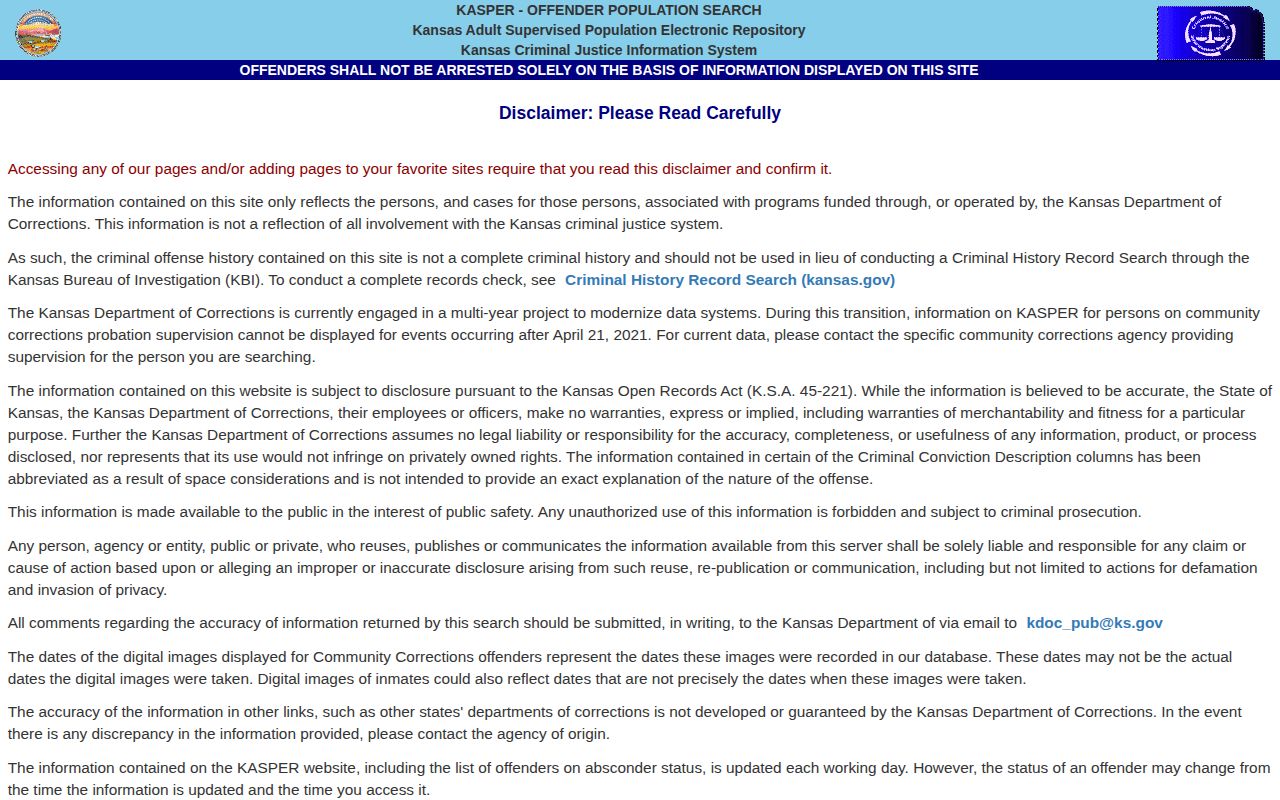
Read that notice before using a future date as more than a current state-record forecast.
Kansas Good Time Calculations
Kansas release computation is not a universal sentence multiplied by 85 percent. For many crimes committed on or after July 1, 1993, K.S.A. 21-6821 sets a general maximum good-time credit equal to 15 percent of the prison portion. Earning and keeping all available credit produces the familiar 85 percent shorthand. It remains a maximum-credit scenario, not a promise that every Kansas prisoner serves the same share.
The statute allows up to 20 percent for specified lower-severity categories, including certain nondrug severity levels 7 through 10 based on offense date and identified drug-grid categories. Some eligible cases also permit program credits. Credit may be withheld, lost, restored, or changed when a lawful sentence correction is entered. For certain sexual or sexually motivated crimes, credit removed from confinement is added to postrelease supervision. Leaving prison and completing the whole sentence are therefore separate events.
Older indeterminate sentences, off-grid and life sentences, and specially governed offenses follow different rules. Under K.S.A. 22-3717, parole eligibility can create an opportunity for Prisoner Review Board consideration. It does not guarantee parole. Conditional release and maximum release also have distinct legal meanings. The offense date, sentence type, minimum term, exclusions, and actual credit record must all be checked.
Note: The Kansas state-prison credit formula should not be applied to a Wilson County Jail term that never became a KDOC commitment.
Why Wilson County Dates Change
Release forecasts move because the facts used to compute them move. Some changes affect the prison portion. Others change the legal authority for release or prevent a person from entering the community. The record should identify which event occurred instead of treating every later date as a clerical error.
| Factor | Possible effect | Best record |
|---|---|---|
| Good-time or program credit | Earned or restored credit may move a date earlier; forfeiture may move it later. | KDOC credit ledger and computation sheet |
| Court order | A corrected, modified, consecutive, or concurrent sentence can alter the calculation. | Journal entry and later court orders |
| Hold or detainer | The person may leave one custodian but transfer to another rather than enter the community. | Release movement and transfer destination |
| Parole decision | An eligibility date may lead to release, a continuance, or a pass under an older sentence. | PRB record and later KASPER status |
| Violation or revocation | A person previously released may return to custody, changing later milestones. | Violation, revocation, and custody records |
A pending charge in another county can also complicate the apparent endpoint. Ask for the release destination, releasing authority, and any transfer disposition. That language distinguishes a true Wilson County community release from movement between jails or into state prison.
Parole Dates Are Not Outcomes
The Kansas Prisoner Review Board handles parole under older indeterminate sentencing structures. Its public-comment schedule lists monthly forums held before the listed residents' parole hearings. The linked list can show a commitment name, KDOC number, county of offense, case number, offense, and earliest possible release month. It is a schedule and comment process, not a release-results database.
A hearing may lead to parole, a continuance to a later month, or a pass that requires conditions before another review. Confirm the later outcome through KASPER status and, when needed, the public part of the PRB decision. “Parole” means release from prison to supervision. “Discharged” is stronger proof that state control ended. An old hearing date alone proves neither.
- Parole eligibility
- The first point at which the Board may consider release under the governing older sentence. Eligibility is not approval.
- Continue
- A Board result that sets another review date, commonly within three years, without granting release now.
- Pass
- A decision that requires stated conditions before another parole review, such as more time or completion of a program.
- Conditional release
- A release point for an indeterminate sentence after the required portion of the maximum term, assuming applicable good time was not lost.
- Maximum release
- The sentence has been satisfied and the PRB and KDOC have no further supervision authority.
The Board's parole process page supplies these outcome distinctions and explains that public comment, the offense, institutional conduct, programs, risk information, staff input, and other statutory factors can inform its decision. For determinate guideline sentences, postrelease supervision normally follows the prison portion; the Board sets supervision conditions rather than selecting the initial prison-release date. If parole is later revoked, an older release event no longer proves that the person remains in the community.
Wilson County Computation Records
A practical state-prison calculation starts with the sentencing journal entry and the prison portion. Concurrent terms run together to the extent the governing order and law permit, while consecutive terms are aggregated. Lawful jail-time credit is applied, followed by the correct good-time ceiling for the offense category and date. The person's actual earned, lost, or restored credit and any authorized program credit must then be reflected. A separate postrelease-supervision term matters when the goal is final discharge rather than the prison exit.
Public arithmetic cannot establish how KDOC applied each part to one person. The sentence-computation sheet and credit ledger can. If KASPER appears inconsistent with a court order, preserve both records and the date viewed, then describe the discrepancy instead of choosing the more favorable date. A written correction message may alert KDOC, while a KORA request seeks the existing documents needed to resolve it.
For a Wilson County Jail term, obtain the local sentencing order and the jail's own record. Research found no published Wilson County policy that supplies a general county good-time formula. Bond, time served, dismissal, sentence completion, and transfer are also distinct events, so the local record must name the release type.
Confirm Wilson County Actual Release
For a county case, request the existing Wilson County Jail booking and release record. Identify the person, approximate booking range, and booking number if known. Ask for the actual release date and time, release type, releasing authority, and transfer destination. The Sheriff's Office is at 925 Pierce Street, Fredonia, KS 66736, and its listed telephone is 620-378-3622. Records-counter hours and a local fee schedule were not published, so ask about the custodian, timing, format, and estimated cost.
For state custody, ask KDOC for the release movement or discharge entry, sentence-computation sheet, credit ledger, and final-discharge record as applicable. Written accuracy comments about KASPER may be sent to kdoc_pub@ks.gov, but the KORA channel is the correct route for an existing formal record. Keep a copy of the KASPER page label and the date viewed.
VINE serves participating Kansas county jails, not KDOC prisons. A custody alert can help track a Wilson County Jail change, while KASPER handles a state-prison case. The VINE Inmate Check explains that split and notification path. Neither a blank search nor a stale future date should replace confirmation from the agency that created the release record.